From Design to Reality: Advancing Manufacturing Innovation at PNW’s College of Engineering and Sciences
In engineering, progress begins with an idea. Real transformation happens when that idea is built, tested, and brought to life.
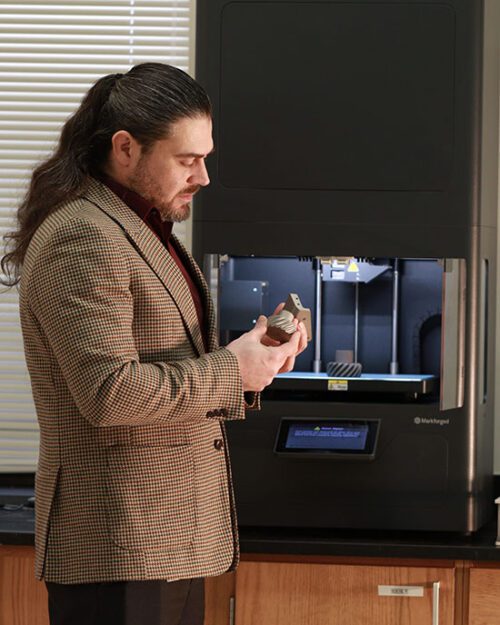
This year, the PNW College of Engineering and Sciences took a major step forward in that journey with the installation of a new metal additive manufacturing system funded through a National Science Foundation Major Research Instrumentation award. Capable of printing materials in metals ranging from copper to steel, the Markforged Metal X 3D printer is more than new equipment. It is a campus-wide resource that expands how our community designs, experiments, and innovates together.
For students, the impact is immediate and tangible. The system is already integrated into coursework, senior design projects, and student organization initiatives. Instead of stopping at digital models or simulations, students now move from concept to functional metal components produced in-house. They gain hands-on experience with modern manufacturing workflows, strengthening their understanding of how engineering theory translates into real-world performance. This is experiential learning at its most powerful.
By enabling metal additive manufacturing on campus, the PNW College of Engineering and Sciences reinforces the connection between theory, experimentation, and real-world outcomes.
Aref Yadollahi, Assistant Professor of Mechanical Engineering

Faculty are leveraging the system to pursue new lines of inquiry and collaborate across disciplines. The platform supports applied research, expands experimental capability, and deepens engagement between engineering and the sciences. It also directly advances the mechanical engineering program’s smart manufacturing concentration, where advanced production technologies are central to workforce preparation and innovation. As Principal Investigator Aref Yadollahi explains, “Meaningful engineering understanding emerges when ideas are built, tested, and refined. By enabling metal additive manufacturing on campus, the PNW College of Engineering and Sciences reinforces the connection between theory, experimentation, and real-world outcomes.”
The installation of this system signals more than a single upgrade. It reflects a strategic expansion of research infrastructure, a commitment to interdisciplinary collaboration, and a clear focus on preparing graduates for the evolving manufacturing landscape. By investing in shared capabilities that serve students and faculty across programs, the PNW College of Engineering and Sciences continues to strengthen its national competitiveness and regional impact.