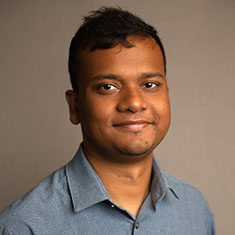
Shafkat Islam, Ph.D.
Assistant Professor of Computer Science
Director of Trustworthy, Robust & Secure Intelligent Systems (TRUST-IT) Lab
Introduction
Shafkat Islam is an assistant professor and the director of the Trustworthy, Robust & Secure Intelligent Systems (TRUST-IT) lab in the computer science department at Purdue University Northwest.
Research Overview
TRUST-IT lab’s research focuses on developing trustworthy, robust, and secure AI agents and safeguarding critical infrastructures/systems when AI agents are integrated into traditional systems. The lab aims to develop efficient, robust and secure systems for applications such as autonomous systems, disaster management, industrial IoT, healthcare and space platforms.
I love exploring mountains and oceans, as time in nature helps me recharge and think creatively. These experiences often inspire innovative ideas that I apply to solving real-world challenges.
Select Publications
- S. Islam, M. H. Chiu, T. Bonjour, R. de Oliveira, B. Bhargava and M. Kejriwal, “A Q-Learning Novelty Search Strategy for Evaluating Robustness of Deep Reinforcement Learning in Open-World Environments,” in IEEE Intelligent Systems, vol. 40, no. 5, pp. 5-15, Sept.-Oct. 2025, doi: 10.1109/MIS.2024.3469574.
- M. T. Hossain, S. Badsha, H. La, S. Islam and I. Khalil, “Exploiting Gaussian Noise Variance for Dynamic Differential Poisoning in Federated Learning,” in IEEE Transactions on Artificial Intelligence, vol. 6, no. 11, pp. 2922-2939, Nov. 2025, doi: 10.1109/TAI.2025.3540030.
- S. Islam, S. Badsha, I. Khalil, M. Atiquzzaman and C. Konstantinou, “A Triggerless Backdoor Attack and Defense Mechanism for Intelligent Task Offloading in Multi-UAV Systems,” in IEEE Internet of Things Journal, vol. 10, no. 7, pp. 5719-5732, 1 April1, 2023, doi: 10.1109/JIOT.2022.3172936.
Teaching Focus
My teaching focuses on database management, AI security, GenAI applications, and big data systems. I emphasize problem-solving and designing secure, scalable, data-driven solutions for real-world applications. Across these areas, students develop skills in computational thinking, system design, responsible AI use, data analysis and evaluating the opportunities and risks of emerging technologies.
Contact
(219) 989-2017
Office Location:
Hammond, CLO 370
Education
- Ph.D. – Computer Science, Purdue University, West Lafayette
- M.S. – Computer Science & Engineering, University of Nevada, Reno
- M.S. – Informatics, Northern Arizona University
- B.S. – Electrical & Electronic Engineering, Chittagong University of Engineering & Technology
Areas of Expertise
- Agentic AI
- AI Security
- Cybersecurity
- Data Privacy
- Quantum Intelligence