Distinguished physics scholar Neeti Parashar provides top-tier learning opportunities for students
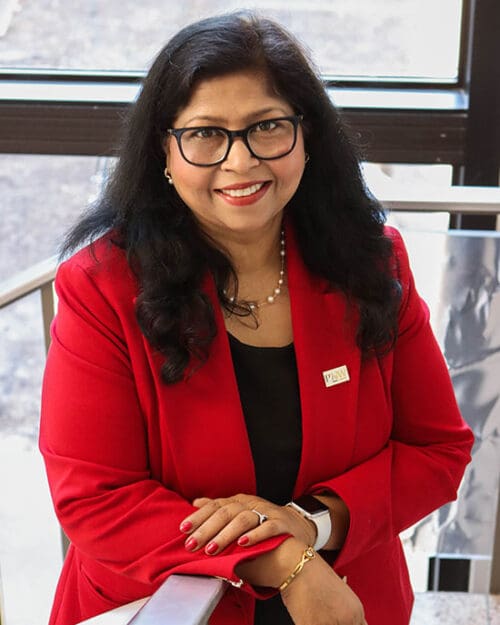
Neeti Parashar, professor of Physics at Purdue University Northwest (PNW), has earned many opportunities and achievements as a physicist and academic. From her classroom at PNW to the massive Large Hadron Collider at the European Organization for Nuclear Research (CERN), she consistently looks for ways to get the students she mentors involved with groundbreaking physics research.
“It is important to share these opportunities with students because these are world-class laboratories,” she said. “Not every physics student gets to experience this, especially at an undergraduate level.”
During 2025, Parashar was part of a large research team that was awarded the prestigious Breakthrough Prize in Fundamental Physics. She is one of approximately 3,000 co-investigators who conduct research on the Compact Muon Solenoid (CMS) experiment at CERN. The award, which included a $3 million prize, is provided to those who make transformative achievements in fundamental physics, life sciences and mathematics. With $1 million apportioned to the CMS experiment co-investigators, the group elected to use the funding to establish grants for graduate students from member institutions.
It is important to share these opportunities with students because these are world-class laboratories. Not every physics student gets to experience this, especially at an undergraduate level.
Neeti Parashar, professor of Physics
Parashar often leverages opportunities for her undergraduate students to analyze, contribute and present research directly tied to high energy physics accelerator operations at both the CMS experiment in Switzerland and Fermilab in Batavia, Illinois. Students earn hands-on experience and communicate directly with leading researchers who investigate key findings concerning the origins and building blocks of matter.
“The students’ work is phenomenal, and they often receive very positive feedback and praise from supervisors at these labs,” said Parashar.
While in the classroom, Parashar sees learning as a two-way street. She, of course, serves as the students’ educator, but they in turn inform her knowledge about what matters to them.
“It is important for me to address students at a wavelength where they will understand basic physics concepts,” she said. “As an educator, you share what you have learned through your experiences, thereby exciting the students. Through this process, they teach you things too about technology, their interests and what they are passionate about accomplishing in their careers. That is truly one of the finest aspects of my approach to teaching.”
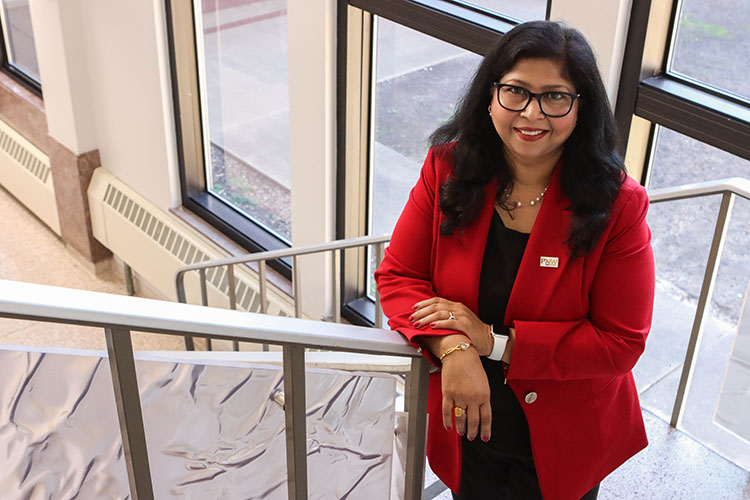
Education and mentorship as crucial tools
Parashar’s professional journey has included achievements such as serving as a co-investigator with the research team that made the historic, Nobel-prize-winning discovery of the Higgs-Boson particle in 2012. Among her many personal accolades, she is a fellow of the American Physical Society, one of the highest professional distinctions by peers in the field.
Parashar can name numerous people who have been influential to her professional journey. One of the most formative was her father, Dayanand Parashar. Dayanand also became a scholar in physics, achieving his doctorate as a Fulbright scholar at the University of Hawaii in a record one-and-a-half years. Even though he received offers to teach at prestigious Ivy League institutions in the U.S., he chose to return to India to support his family and children as a faculty member at the University of Delhi.
“My father came from a very humble background,” Neeti Parashar said. “He would tell me that you should always want to do the best in whatever you choose to do, which has stayed with me. He also often emphasized that one of the most powerful ways to change your life for the better was to use education as the tool. For many years I have seen my career as my turn to impart these pieces of advice to my students.”
What helps enhance these commitments to education and personal development are the opportunities others can provide for you, Parashar says. During her academic career at PNW, she credits Kenneth C. Holford, PNW’s Chancellor and a previous dean of the College of Engineering and Sciences, for supporting her in pursuing grants, research opportunities and more, which could be used to sponsor students’ involvement in premier research venues, such as CERN and Fermilab.
By engaging undergraduate students directly in meaningful research, she is helping prepare the next generation of scientists while advancing discovery in her field.
PNW Chancellor Kenneth C. Holford

“Chancellor Holford has consistently provided his strong, rock-solid support to facilitate my work” said Parashar. “When you have someone in a higher position with authority and resources, and who stands with you in your corner, it can change everything. That is exactly what I want to provide for my students too.” Parashar’s work has a strong impact in Northwest Indiana by supporting and training high school students and high school teachers in particle physics.
“We are proud of Professor Parashar for her excellence in high energy physics and her extraordinary dedication to mentoring students,” said PNW Chancellor Kenneth C. Holford. “By engaging undergraduate students directly in meaningful research, she is helping prepare the next generation of scientists while advancing discovery in her field.”
When Parashar reflects on many of these accomplishments throughout her career, she appreciates the cumulative impact of mentors and peers who guided her and helped steer her toward lifechanging opportunities. She applies that same mindset constantly for her students, paying it forward and opening doors so they can realize their dreams too.
“In the end, we, as university faculty and staff members, are here because of them and also here for them.”