Unions, Race, and Popular Democracy: Building a Progressive Labor Movement (2026)
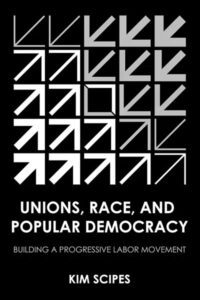
Unions, Race, and Popular Democracy: Building a Progressive Labor Movement
Published Reviews:
Steve Early. “Can CIO Best Practices Aid New Union Organizing Now?”
First publication: New York Labor History Association, August 20, 2026.
Steve Early’s Review Republished in:
- Against the Current/Solidarity, September 1.
- Counterpunch, September 4.
- Green Social Thought, August 22.
- Hollywood Progressive, September 2.
- New Politics, August 21.
- Popular Resistance, September 1.
- Z Net, September 2.
Listen to Kim Scipes on WIMS Radio, Michigan City, Indiana, August 27, 2026.
Listen to Dr. Scipes talk about his new publication, Unions, Race, and Popular Democracy: Building a Progressive Labor Movement with Ric Federighi on WIMS AM.
Ric Federighi: We are WIMS AM 14209511067 FM. Ric Federighi on the dial. Several thousand of you on the listen live feature. Of course, local news headlines, including the latest on the outages and things and ways that we can help in and around the area on the front page of WIMSRedo.com.
Dr. Kim Scipes, PhD, a global labor scholar, professor emeritus of sociology at Purdue University Northwest in Westville, a former industrial worker, printer, and a longtime labor activist, joins us right here on WMS to talk about his new book, Talk to Me a Little Bit. Thank you for coming on the show. Really excited to have you on today.
Kim Scipes: Well, thank you. I’m glad to be here.
Ric: So my book is called Unions, Race, and Popular Democracy: Building a Progressive Labor Movement. I love it. Give us a little skinny on this because obviously you are well known all around the world with what you are doing. But talk about your deep dive into this. Give us a little insight, and then we’ll get into some Q&A here, please.
Kim: Okay. So this is the labor history of the region. It covers basically South Chicago down to the Calumet region all the way to Gary. What I’m doing is I’m looking at the unionization processes in both steel and meatpacking from 1933 to 1955, basically the CIO years. And what I found surprised me, but it was two radically different approaches to trade unionism. The meat packers took a very expansive view, while the steel workers didn’t. They took a very narrow view.
And because I found two different approaches to unionism, I decided to look at a common problem, that being white supremacy and racism, and looked at how the unions addressed that. The steelworkers ignored it, basically, allowing it to continue from what the steel companies had originally set up, while the meatpackers attacked it head-on. And in fact, in 1939, in racist, segregated Chicago, out of 14 packing house locals, eight were headed by African-Americans.
Ric: Wow. Yeah.
Kim: So this is stuff that’s not known. I was very surprised to find out that despite Northwest Indiana at times producing as much steel as Pittsburgh at times and even more and having a larger membership in the United Steelworkers once it was established, that there’s been no academic history of the region.
And so I get into this; I’ve got some great stuff on Gary that nobody has ever seen other than the person that wrote it. I’ve got surveys of black steelworkers in 1937.
Basically, you had a man named Claude Barnett working for the US steel company trying to see if blacks would honor a CIO strike.
What he found out was they probably wouldn’t. So that was one of the reasons the steel signed with John L. Lewis and the CIO. So it’s very interesting. There’s been some stuff done on Packinghouse.
It had a very radically different approach, very bottom-up, very democratic, run by the members. And to look at the two unions and compare them gives you a view that you just can’t get anywhere else.
Ric: What made you obviously jump into this topic? Was this something near and dear to your heart? Was this something that you had done research on throughout your tenure? Talk to me about that a little bit.
Kim: OK, no, this was actually the bulk of this was my PhD dissertation, which I did at the University of Illinois, Chicago. Basically, what I was doing, I had been part of an international debate over what kind of unionism we were seeing in places like the Philippines, South Africa, and Brazil.
And we were trying to understand that, and I was part of that process. And then I wanted to see three different types of unionism, what we call economic, political, and social movement unionism. We had economic unionism in the United States, and I wanted to see if we could delineate between the more conservative and more progressive approaches to this economic trade unionism.
And so that’s why I started searching that. Now, after I did my PhD, I decided to work on the global level. So I did three books on global trade unionism, but this one wouldn’t let me go. It was too good to let go, and I wanted to publish. I’m really excited about it.
Ric: So are you doing? I’ve got a couple of people asking where they could get the book, number one. Number 2, are you doing any kind of a local tour where you’ll be signing books and stuff like that? Inquiring minds want to know.
Kim: Yes, well, I’ve got answers. First of all, now you can get it at Amazon; you can get it at Barnes and Noble; you can even get it at Walmart, things like that. I want to do local speaking engagements. I’ve got one set up with the press in Valparaiso, downtown Valparaiso, that will be on September 20th from 2 to 4 P.m. I’ll be speaking there. I’m looking for others.
So people, if they’re interested, they can help me set it up and get in touch with me.
My e-mail is kcipes, that’s S-C-I-P-E-S, at pnw.edu.
Ric: What was the most, I don’t want to say surprising, but something that made you step back and said, huh, information that you put in the book or something that you used where you’re like, you didn’t even think that was going to be there, but anything that A surprised you or B, that was like a slap of reality, wow, based on what you were doing for that time of, you know, the United States of America. It’s kind of cool.
Kim: Yeah, well, I actually really got one. There was a lot of people don’t know this, but in 1937, it was actually Memorial Day in 1937. There was a massacre of people in South Chicago. Ten men were killed. I know a woman and a young child were wounded.
There were about 90 wounded altogether. And this was in the beginning of the little, what became known as the Little Steel Strike. And that was pretty, you know, I knew about that, but I got, I got more details and stuff like stuff along those lines.
But what really stunned me was about a month after, month or two after, Anthony Fontacchio, who was the regional director of the Steelworkers Organizing Committee, who really pushed a top-down, very restrictive form of unionism.
He met with the upper echelon of Inland Steel management, and in front of management told his members not to have any disruptions, that they were not going to look for problems or anything like that.
They were going to be good boys and basically go along with the program. And I found this on the transcript of this meeting it was word for word, it was typed. There’s no misconception or screwing that one up; it was dead blank and it really it really surprised me.
Ric: Wow, absolutely wonderful. Continued success and all that you do. Again, throw that out there: two more people asking about where these books are at. I know you said Walmart, Barnes and Noble what else? Amazon.
Kim: Amazon. You can get it from Cornell University Press if you go there and look under- I think it’s listed under US history- but you can get it there, and that way, that way any money goes through the press. So I support that best.
Ric: All right, cool. Dr. Kim’s e-mail: KSCIPES at pnw.edu. Again, KSCIPES at pnw.edu. Anytime you want to pop on, let me know. Continued success and thanks for all you do for our area. This is really cool. Congratulations again.
Kim: Well, thank you and thanks for having me. I really appreciate it.
Ric: Of course, thank you. We are WIMS AM 1420-951-1067.