Possibilities – Volume 3, Issue 1 – Fall 2026

Volume 3, Issue 1 – Fall 2026
PNW Accessibility Center
Success starts with Access
Welcome to the PAC’s fourth issue of Possibilities. Possibilities highlights students, faculty, and staff who help make PNW an accessible environment for all.
Volume 3, Issue 1 includes the following stories:
- PAC’s Work with Students: Investment in Retention
- Trust in PAC Inspired Student to Choose PNW
- Who Uses the PAC?
- Faculty Access Plan Read Rates
PAC’s Work with Students: Investment in Retention
A typical day in the PNW Accessibility Center (PAC) is usually not so typical. Serving more than 550 students, this office of less than six full-time employees is called upon to perform any number of tasks throughout the day. These can range from proctoring multiple individually accommodated exams and consulting with faculty and medical providers to implementing assistive technology and de-escalating students in crisis. Many students who are registered with the PAC have been diagnosed with ADHD, diabetes, dyslexia, or anxiety, while others may be recovering from a concussion, a Crohn’s disease flare-up, or a mental health episode. Regardless of the diagnosis, the mission of PAC staff is to provide an accessible PNW experience for all students.
Data from PNW’s Institutional Research department suggests that PAC services are helping students remain enrolled and succeed. Retention rates for students registered with the PAC increased from 77.4% in Fall 2023 to 83.7% in Fall 2024, compared with 75.1% and 77.1% for non-PAC students during the same period. Among first-time in college (FTIC) students, retention rose from 67.5% to 76.9% for PAC students, while non-PAC FTIC students increased from 65.8% to 70.1%.
PAC 1-Year Retention Rate (FTIC Students) vs. PNW Non-PAC Students
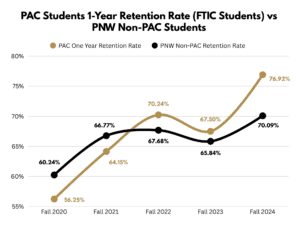
PAC 1-Year Retention Rate (FTIC Students) vs. PNW Non-PAC Students
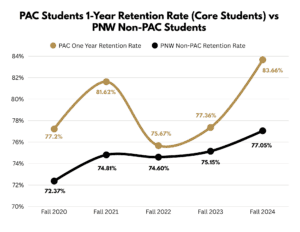
These gains are especially noteworthy because students with disabilities have historically experienced lower rates of retention and belonging in higher education. The PAC helps address these challenges by providing access through accommodations that enable students to fully demonstrate their abilities while maintaining the university’s academic standards.
Many accommodations are simple and low-cost, such as providing a quiet testing environment for a student with PTSD or extended exam time for a student with dyslexia. Beyond accommodations, the PAC also serves as a resource and support network for students navigating college with a disability. Student feedback highlights the impact of these services. One student described the PAC as a “vital resource” that helped them obtain secure, needed support. Another compared the PAC to “a compass,” guiding students along the right path with encouragement and support.
Trust in PAC Inspired Student to Choose PNW
For Benjamin Rutkowski*, attending college was always part of the plan. But as a student with Type 1 diabetes, finding a university with strong disability services was a top priority.
When he arrived at Purdue University Northwest, Benjamin connected with the PNW Accessibility Center (PAC), which helped create an Access Plan that included classroom breaks, access to medication and snacks, and accommodations for monitoring his blood sugar. “The PAC made it to where I felt I had a fair chance,” Benjamin said. “It gave me peace of mind.”
The PAC made it to where I felt I had a fair chance.
Because Benjamin relies on an app that tracks his blood sugar and sends alerts, he needs access to his phone at all times, including during exams. With this accommodation, the student’s phone remains face down unless an alarm sounds. Benjamin said it was important for his professors to know he wasn’t cheating on exams (all PAC students are on camera while testing), and the PAC helped ensure his professors understood this medical necessity.
Benjamin graduated in May 2025 with a Bachelor of Science in Electrical Engineering and now works at a local engineering firm. Looking back, he describes his PNW experience as “phenomenal” and credits the PAC with helping him succeed. “The PAC provided me the support I needed to stay here,” he said.
*Student information is confidential at the PAC. Benjamin gave the PAC permission to use his name.
Who Uses the PAC?
Diagnosis Trends
Student diagnosis trends showed mental health and learning disabilities continued to drive accommodation needs, injury-related cases increased sharply, and a growing number of students required individualized support due to multiple diagnoses.
Classification Trends
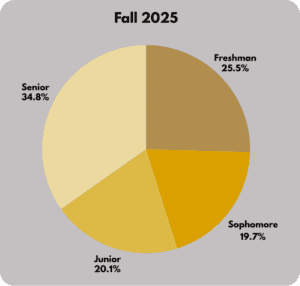
Fall 2025: The PAC student population reflected a balanced mix of class standings, with seniors representing the largest group at 34.8%, followed by freshmen at 25.5%, juniors at 20.1%, and sophomores at 19.7%. Overall, the population was fairly evenly distributed, with upper-class students (juniors and seniors) making up just over half of all students served by the PAC.
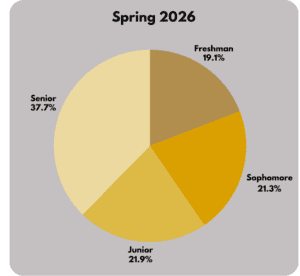
Spring 2026: The PAC student population shifted slightly toward upper-class students, with seniors increasing to 37.7% of the population. Juniors and sophomores accounted for 21.9% and 21.3%, respectively, while freshmen represented 19.1%. Together, juniors and seniors comprised nearly 60% of the students served, reflecting continued engagement and retention of students as they progressed through their academic careers.
Faculty Access Plan Read Rates
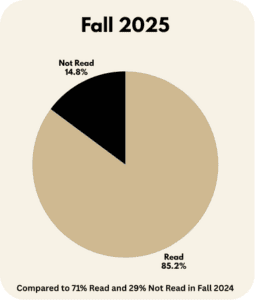
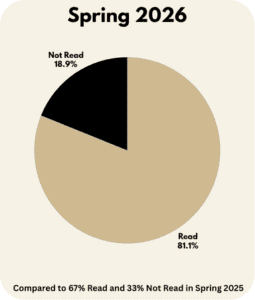
Faculty engagement with student Access Plans remained strong during both the Fall 2025 and Spring 2026 semesters. In Fall 2025, 85.2% of Access Plans were read, an increase from 71% in Fall 2024. Similarly, in Spring 2026, 81.1% of Access Plans were read, up from 67% in Spring 2025
A big thank you to faculty for reviewing their students’ Access Plans during the Fall 2025 and Spring 2026 semesters.