PNW’s Water Institute takes interdisciplinary approach to key research area
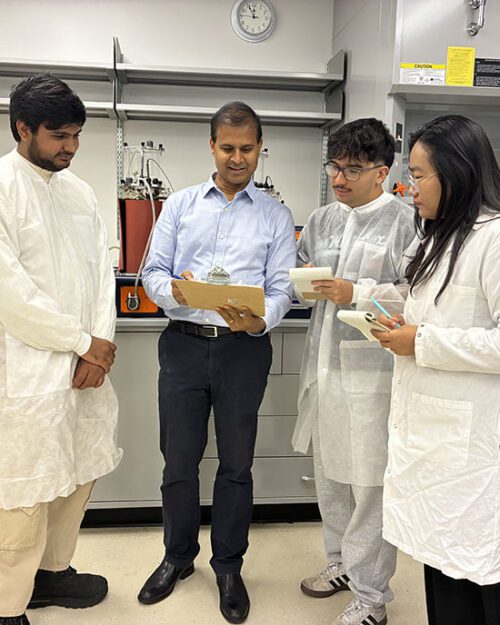
From left to right, Hirak Modi (MS’26); Veera Gnaneswar Gude, NiSource-Meyer Charitable Foundation Professor of Energy and the Environment and director of the PNW Water Institute; Rodolfo Castro, third-year Civil Engineering major; and Khin Tun (MSCE’26) hold a meeting in the PNW Water Institute lab space in the Schneider Avenue Building to discuss findings from ongoing research projects.
Northwest Indiana’s location in the Lake Michigan basin offers wide-ranging benefits with access to one of the world’s greatest freshwater resources. It also provides unique opportunities for education and research on innovative solutions that will maintain water quality across its many uses in local communities.
The Purdue University Northwest Water Institute advances interdisciplinary applied research for studying water resilience and supporting workforce development. It’s an approach that is becoming more necessary for addressing the complex challenges faced by water consumers, from personal use to large-scale agriculture and industry.
“We sit at a juncture of urban, suburban and rural environments where our region is a dynamic bridge between these different communities who share common water resources,” said Veera Gnaneswar Gude, the director of the Purdue University Northwest Water Institute and NiSource-Meyer Charitable Foundation Professor of Energy and the Environment. “Part of our mission is centered on community engagement so that we can disseminate the knowledge we are discovering and be of service to our communities’ needs and objectives.”
More than a drop in the bucket
Applying this broad lens to researching water quality often begins with understanding water footprints, or tracing the journey of how water is used to develop different goods and processes.
“Let’s say you have some type of fruit or meat that you plan to eat,” Gude said. “How much water was used to grow that produce or sustain that animal? How much was used to gather and transport those food products? How much wastewater was produced? This is just one example related to agriculture, but these questions help us start to think about the different water footprints we are responsible for.”
Part of our mission is centered on community engagement so that we can disseminate the knowledge we are discovering and be of service to our communities’ needs and objectives.
Veera Gnaneswar Gude, the director of the Purdue University Northwest Water Institute and NiSource-Meyer Charitable Foundation Professor of Energy and the Environment
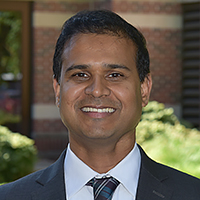
Before becoming a university educator, Gude worked as a chemical engineer for DuPont. His exposure to water use challenges in Singapore’s textile industry inspired him to think larger about the mutual relationships between water consumption, energy production and water pollution. His research focus examines these relationships and emerging solutions for efficient wastewater treatment and nutrient recovery.
He was drawn to PNW and the Water Institute research center for the unique opportunity to apply this praxis with the region’s diverse water usage in the Lake Michigan basin, and to help students bridge across areas of study to research solutions.
“There are many professionals in areas that concentrate on water, such as agriculture, that are aging out of the workforce,” Gude said. “Research ventures such as the Purdue University Northwest Water Institute are helping prepare graduates that can bring that interdisciplinary perspective to industries that are facing old and new challenges.”
Converging perspectives
Since 2022, Gude has helped students and the Purdue University Northwest Water Institute pursue research enterprises that benefit both academic and community partners’ understanding of new solutions in water consumption, energy production, nutrient recovery and other processes. Several of these opportunities are funded through the National Science Foundation and the U.S. Department of Agriculture and have amounted to over $2 million in sponsored research.
Gude challenges students through traditional coursework and research ventures to see the interdisciplinary crossovers that benefit their understanding of investigating new solutions. Research questions can often bridge disciplines such as engineering, technology, computer science and biological sciences. The work prepares students to study problems through multiple lenses in their future roles.
Khin Tun (MSCE’26) was drawn to do research at PNW under Gude’s mentorship after earning professional experience in construction in Singapore. Her curiosity about how infrastructure transports water led her to pursue a master’s degree in Civil Engineering. Her research at the Purdue University Northwest Water Institute exposed her to impactful investigations, such as microbial fuel cell energy production in municipal wastewater.
“Wastewater treatment plants usually consume great amounts of electricity,” Tun said. “My research looked at the microbes that are present in wastewater and how those bacteria can generate electricity. These bacteria release electrons, which we can capture and turn into renewable energy. Thus, you have a dual benefit of treating wastewater while also generating electricity.”
Tun’s research helped her earn a full-time job offer with the Gary Sanitation District before completing her master’s degree.
“My experience was valuable because it showed me how many different technologies there are for treating wastewater,” said Tun. “I also worked with students who represented other disciplines. I learned about chemistry, mechanical engineering, data analysis and more that helped me think differently than just a civil engineer.”
Making waves
The Purdue University Northwest Water Institute’s research investigations are benefitting from collaborations the center has initiated with agriculture, municipal utilities and sanitation districts, government agencies and industry partners. The research center’s interdisciplinary foci are positioning valuable expertise for these various partners as communities manage challenges with water consumption, wastewater treatment and nutrient recovery.
Examples of the research center’s impacts have included advances in solutions for hydroponics, or the soilless growth of plants; producing renewable energy from microorganisms in water samples; recovering clean water and nutrients from polluted samples; cybersecurity and machine learning models to monitor water quality and security; desalination and more.
“Being engaged and open with our community members rather than working independently in the lab helps with breaking boundaries,” said Gude. “Our research is gaining international reputation and we want to be a contributor to our communities in a way that promotes progress for their different challenges.”
To learn more, visit pnw.edu/water-institute.