CIVS Graduate Research Assistant, Nihal Saji, Successfully Defends Master’s Thesis

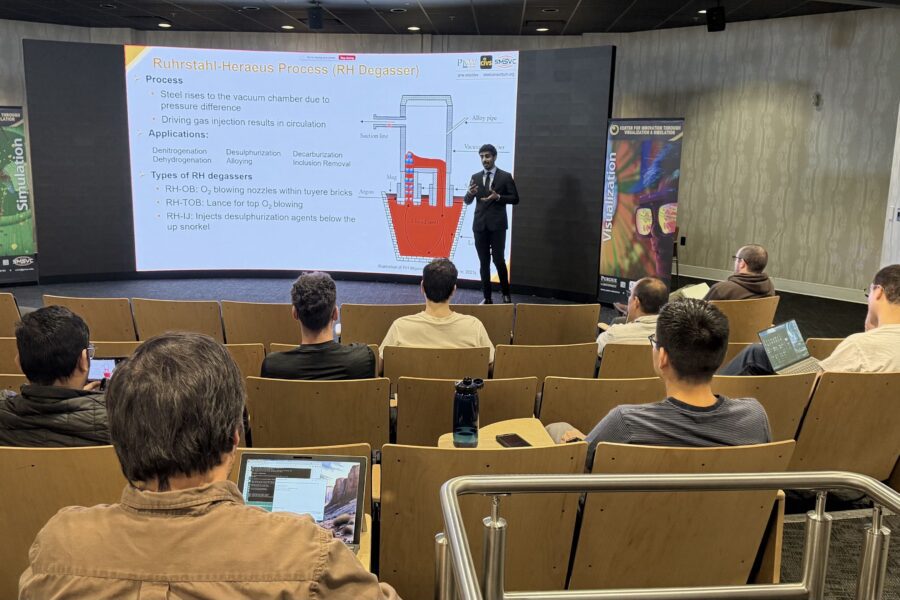
 Congratulations to CIVS Graduate Research Assistant, Nihal Saji, on successfully defending his Master’s Thesis “Numerical Investigation of Flow Optimization and Mixing Dynamics in RH Degasser” on March 31.
Nihal will receive his Master of Science in Mechanical Engineering degree from Purdue University Northwest. His research was conducted at the Center for Innovation through Visualization and Simulation (CIVS) under the supervision of CIVS Director Prof. Chenn Zhou, Professor by Courtesy at Purdue University’s School of Mechanical Engineering. He also was in collaboration with U.S. Steel, a charter member company of SMSVC.
This study focuses on developing a high-fidelity multiphase computational framework to analyze flow circulation and mixing dynamics in an industrial-scale RH degasser. A coupled Volume of Fluid–Discrete Phase Model (VOF–DPM) approach was implemented to simulate gas–liquid interactions, molten steel circulation, and tracer-based mixing behavior. The model was validated using a concentration-based mixing time criterion and further refined through mesh convergence studies to ensure numerical accuracy.
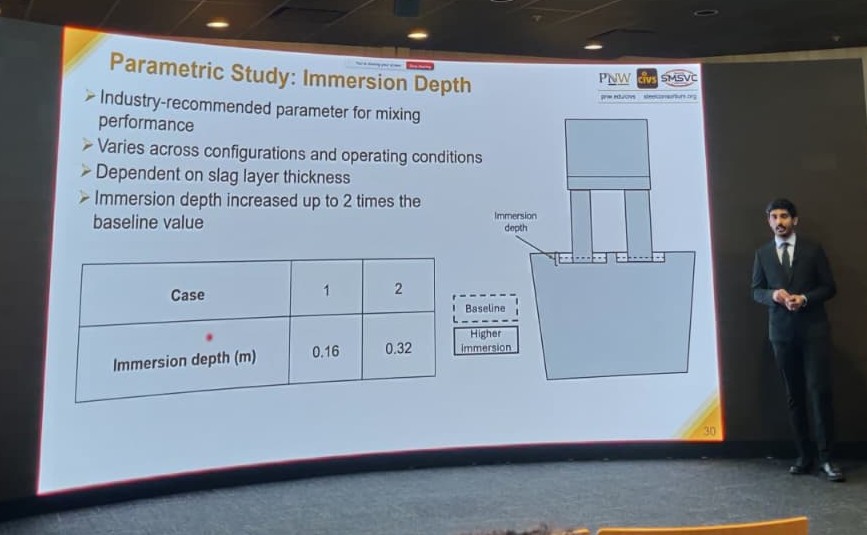
A systematic parametric study was performed to evaluate the influence of key operational and geometric parameters, including gas injection flow rate, snorkel diameter, immersion depth, and snorkel offset position. The results demonstrate that mixing efficiency in RH degassers is primarily governed by large-scale circulation rather than localized turbulence effects. An optimal gas injection range was identified, beyond which further increases in yield diminish returns due to geometric constraints.
Additionally, increasing snorkel diameter, particularly the down-snorkel, was found to significantly enhance mixing performance, while excessive immersion negatively impacts circulation strength. Although snorkel offset improves mixing uniformity, it introduces trade-offs by reducing the overall circulation flow rate. These findings highlight the importance of balancing operational parameters and system geometry for optimal performance.
The developed computational framework provides a robust tool for improving RH degasser design and operation, enabling enhanced mixing efficiency, reduced processing time, and improved process consistency in industrial steelmaking applications.
At CIVS, Nihal Saji actively collaborated with industry partners through SMSVC, including U.S. Steel, gaining valuable exposure to real-world steelmaking operations. This experience strengthened his technical expertise in CFD, multiphase modeling, and simulation-driven design, while also enhancing his ability to address complex industrial challenges.
CIVS has played a significant role in my technical and professional growth. I’m especially grateful to the CIVS staff and mentors for their guidance and for fostering a highly collaborative environment for students. Working on real-world problems alongside industry partners was a truly rewarding experience, and I’m thankful to have been part of this journey.