CIVS & SMSVC AI Research Presented at TMS Specialty Congress
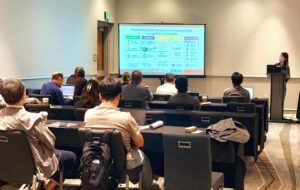 On July 9, CIVS Ph.D. student Shiyu Wang presented at the 4th World Congress on Artificial Intelligence in Materials and Manufacturing (AIM 2026) in Anaheim, CA. AIM 2026 is a series conference a part of the 2026 TMS Specialty Congress. Her presentation was titled “Accelerated Prediction of EAF Melting Processes Through an Xgboost-Based Reduced-Order Model”. Co-authors include Orlando Ugarte (CIVS Research Scientist), Sunday Abraham (SSAB), Yufeng Wang (SSAB), Randy Petty (SSAB), Hong Wang (Oak Ridge National Lab), Ty Okosun (CIVS Associate Director for Research), and Chenn Zhou (CIVS Director). SSAB is a charter member company of SMSVC.
High-fidelity computational fluid dynamics (CFD) simulations are used to describe the scrap melting in a DC Electric Arc Furnace (EAF). However, the computational cost of CFD simulations limits their applicability in real-time optimization and control. This work presents a machine-learning–based reduced-order model (ROM) using Extreme Gradient Boosting (XGBoost) trained on a CFD dataset including variations in arc power of a real DC-EAF operation provided by SSAB. The training data captures the time evolution of critical melting parameters, including scrap mass, molten steel mass, and bath temperature, enabling the ROM to learn the nonlinear dynamics of the melting process. In addition, the ROM is extended to predict full heat progression using only initial furnace conditions through a recursive forecasting approach. Results show that the XGBoost-based ROM closely matches CFD predictions for key variables while cutting computation time from hours to milliseconds, allowing for near-real-time evaluation of melting behavior.
The 4th World Congress on Artificial Intelligence in Materials and Manufacturing (AIM 2026) is the fourth event of its kind to focus on the role of artificial intelligence (AI) in materials science and engineering and related manufacturing processes. AIM 2026 will convene stakeholders from academia, industry, and government to address key issues and future pathways.
Manufacturing is increasingly relying on a wide range of tools, including AI, to improve efficiency and drive innovation. One of AI's greatest strengths is its ability to make fast predictions and support decision-making. One of my biggest takeaways from the conference was that high-quality databases are the foundation of any successful AI application, regardless of the model being used. I also learned that validating AI simulations with real-world plant operations is essential for building reliable and trustworthy AI tools.