Keynote presentation on CIVS AI & CFD research at AIST Digital Transformation Forum
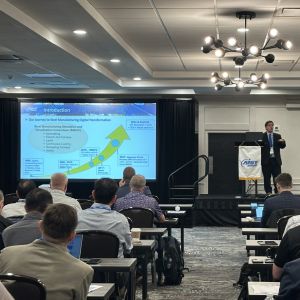
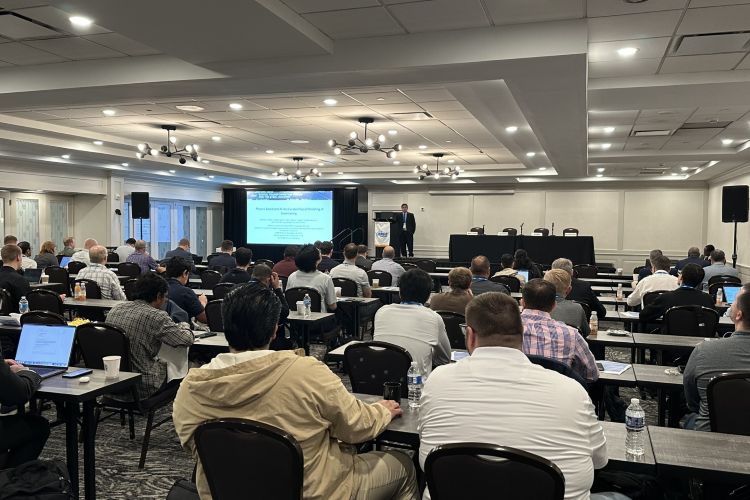
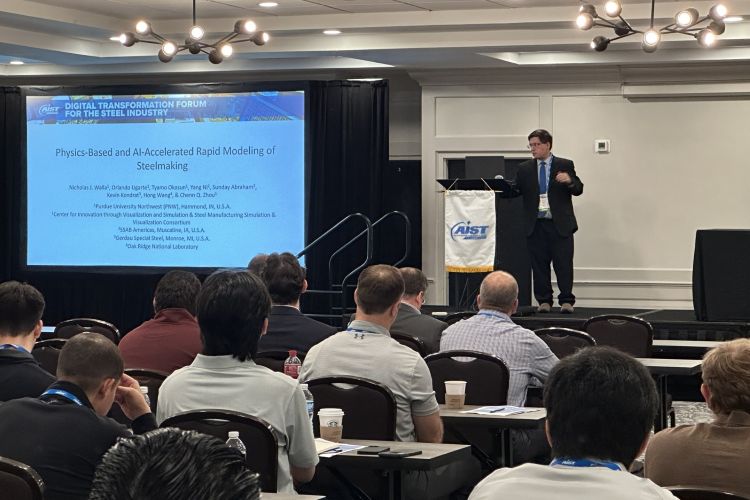
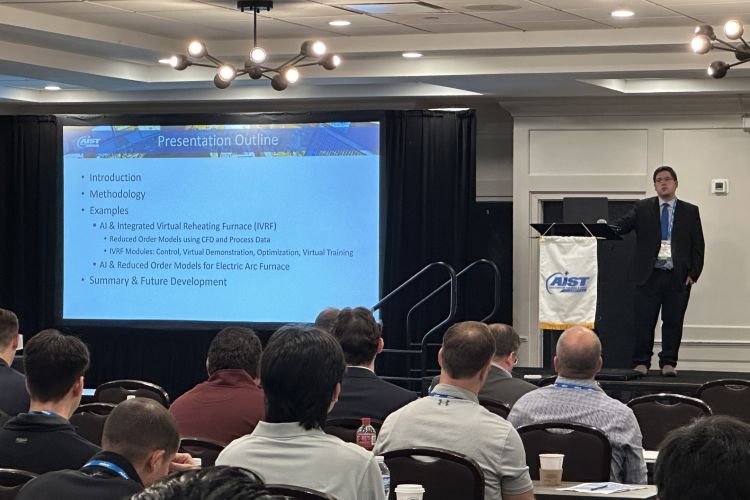
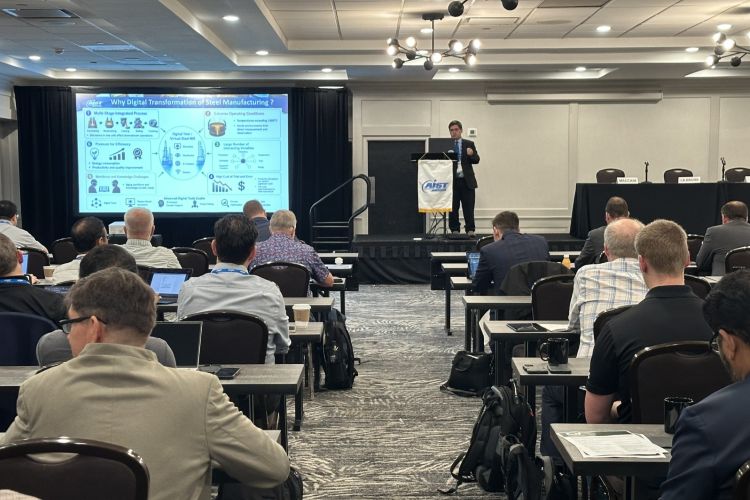
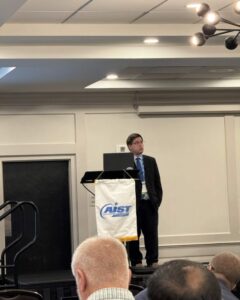 On October 14, CIVS Senior Research Engineer Nicholas Walla was invited to deliver the keynote presentation, “Physics-Based and AI-Accelerated Rapid Modeling of Steelmaking,” at the Association for Iron & Steel Technology (AIST) Digital Transformation Forum for the Steel Industry 2026 in Pittsburgh, PA. Co-authors included Orlando Ugarte (CIVS Research Scientist), Tyamo Okosun (CIVS Associate Director for Research), Yang Ni (PNW Assistant Professor of Computer Science), Chenn Zhou (CIVS Director), industrial collaborators Sunday Abraham and Yufeng Wang (SSAB Americas), Kevin Kondrat (Gerdau Special Steel), and Hong Wang (Oak Ridge National Laboratory). The presentation highlighted the long history of applied computational fluid dynamics (CFD) research at CIVS and discussed methodologies for integrating computer simulation, augmented reality/virtual reality (AR/VR), and artificial intelligence. It also showcased recent advances in physics-based, AI-driven Reduced Order Modeling (ROM) and Integrated Virtual Processes (IVP) for the steel industry, along with high-impact project applications across a variety of ironmaking and steelmaking processes. Prof. Zhou, Prof. Ni, and Nick Walla also participated in the AIST Digital Transformation Committee Meeting.
Computational fluid dynamics (CFD) models have proven invaluable tools for in-depth analysis, design modification, and optimization of complex, high-temperature processes involving multiphase reacting flow and similar phenomena. These models have been employed to accurately predict steelmaking processes such as scrap melting in the electric arc furnace and product reheating in the hot strip mill. However, while such modeling has provided a wealth of physical understandings related to these processes, their complexity and scale result in significant limitations for the direct use of these models by process engineers for guidance or operation in an industrial environment. To address this challenge and enable industrial access to high-quality CFD modeling insights in a faster timeframe, a method has been developed to generate fast-running Reduced-Order Models (ROMs) trained by artificial intelligence (AI). This process involves the creation of a validated baseline CFD simulation with a good degree of accuracy relative to the industrial process, the simulation of a range of operating conditions using high-performance computing resources, and the processing of that data into a form which can be used to train an AI ROM with neural network, XGBoost, or other machine learning algorithms for numerical data. This ROM can then be used to rapidly answer “what-if” questions, provide guidance and feedback to operators, and potentially even support or interface with existing level two systems for a given process in future.
This modeling approach was first developed to provide a more accurate alternative to blast furnace operation rules of thumb and is now being applied to two additional significant steelmaking processes. First, the approach has been applied to develop a model capable of predicting scrap melting in an industrial DC Electric Arc Furnace (EAF). A baseline simulation was validated against industry data to within 10% of real-world conditions, with data extracted in ten second intervals for reduced order modeling including average liquid temperature, mass of melted material, and electrode position, enabling a virtual heat to be rapidly run with a given profile of input conditions such as burner power, electrode power, and charge recipe, allowing operators to utilize the AI-trained models to preemptively assess expected time for a given heat. The approach has also been applied to simulate the product heating curve in a walking beam reheating furnace, with outputs for the ROMs to include thermocouple readings and product heating curve for varying hydrogen fuel usage and oxygen enrichment within the furnace. Rapid prediction of this information can allow operators to explore alternative fuel usage without risks to product quality or production. Additionally, a high-quality prediction of product heating in the furnace could be incorporated into existing level two systems to supplement current calculations of slab core temperatures based on internal furnace thermocouple data.
The 2026 Digital Transformation Forum for the Steel Industry brought together steel producers, technology experts and innovators to discuss the ongoing evolution of digitalization across the steel industry. Building on the momentum of previous forums, this year’s program focused on the practical realities of artificial intelligence (AI), highlighting current applications within the steel industry and examining the requirements for successfully delivering value through AI technologies.
The program centered on generative AI as a transformative technology, with presentations and discussions exploring its application to plant challenges such as safety, predictive maintenance and process innovation. Through case studies, panel discussions and technical papers, participants examined key factors for successful implementation, including data readiness, data quality and effective integration strategies. Attendees also gained insight into the ways generative AI is reshaping steel industry operations, supervision and process automation.
Designed for decision-makers, technical leaders and digital transformation professionals, the forum provided attendees with actionable insights for launching, scaling and sustaining digital transformation initiatives within their organizations. The event also fostered collaboration and knowledge sharing among industry leaders navigating the rapidly evolving landscape of AI and digital transformation. (Digital Transformation Forum for the Steel Industry)