Undergraduate Research Students Presented at CIVS Seminar
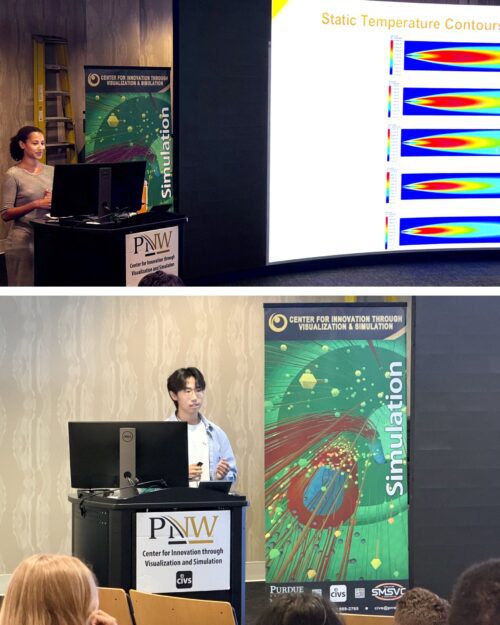
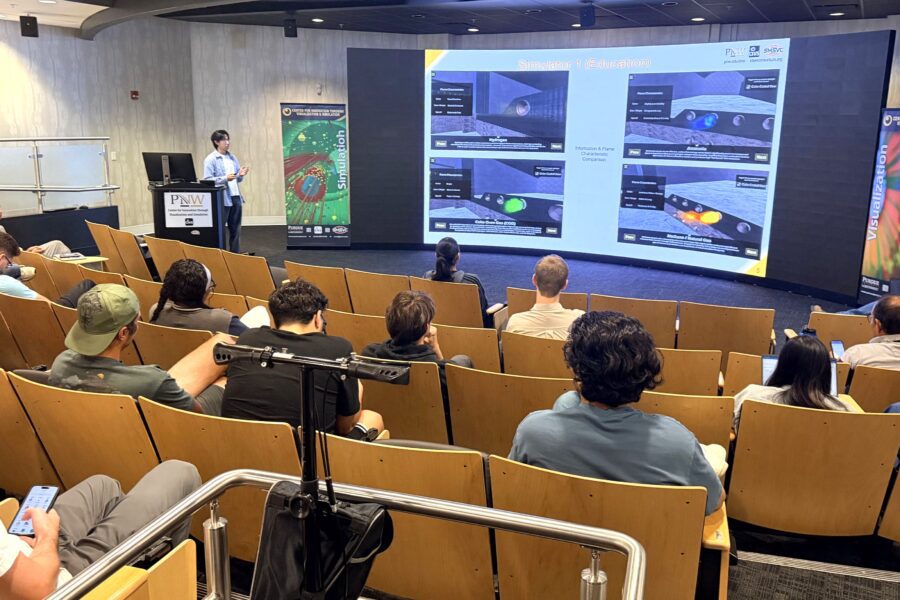
 On July 21, CIVS hosted a seminar for CIVS undergraduate research students Tyra Conner (ME) and Daniel Kim (CS) to present their research for the PNW Research and Extension Experiences for Undergraduates (REEU) program. They conducted their research at CIVS on reheating furnace simulation and visualization this summer mentored by CIVS research staff and students.
Tyra presented “Hydrogen Combustion Characterization using Computational Fluid Dynamics”. This research presents the numerical representation of the characteristics of a hydrogen-fueled turbulent diffusion flame in a 2D axisymmetric cylindrical combustor. Computational fluid dynamics (CFD) simulations were conducted using ANSYS Fluent R1 2023 to investigate the impact of oxygen enrichment across five distinct operating cases: 21% (air), 30%, 40%, 50%, and 100% (pure oxygen) O2 concentrations. The chemical reactions and turbulence chemistry interactions were modeled using the Eddy Dissipation Model (EDM). Temperature profiles were systematically extracted to characterize thermal boundaries across varying oxygen-enrichment conditions. Results indicate that oxygen enrichment significantly accelerates reaction rates, leading to higher peak temperatures, NOx production, and a pronounced shortening of the overall flame length. These findings provide critical quantitative insights into the characterization of hydrogen combustion, which is the foundational work needed to progress industrial activities towards decarbonization.
Daniel presented “An Interactive Digital Twin for Visualizing Agriculturally Sourced Hydrogen and Alternative Fuel Combustion in a Steel Reheating Furnace”. Recently, steel reheating furnaces have faced growing pressure to decarbonize as global climates surge higher than ever. As a result, hydrogen gas (H2) has taken the spotlight as a promising alternative fuel source since its combustion produces no carbon dioxide. However, its future depends on where the hydrogen comes from. Agricultural waste, such as crop residue and manure, is a low-cost option that can yield hydrogen through biochemical processes like dark and photo-fermentation. This paper discusses fuel sourcing alongside the challenge of introducing alternative fuels such as hydrogen gas, ammonia, and coke oven gas into a furnace where their combustion speeds, flame temperatures, and safety requirements set them apart from natural gas. To help make these differences tangible, I worked on optimizing an existing interactive Unity digital twin that lets the user explore and compare combustion behavior across natural gas and the three alternative fuel options. The digital twin also includes a visualization of the furnace purging sequence required under NFPA 86. Ultimately, this work visualizes and translates CFD simulation results and literature-grounded behavior in order to support operator training as the steel industry moves toward zero-carbon fuels.
The PNW REEU program is led by Professor Veera Gnaneswar Gude and sponsored by the U.S. Department of Agriculture (USDA).
While working at CIVS, I got to learn alongside talented peers and mentors while quickly developing my skillset in Unity through real projects and issues. I'm very thankful for my experience and proud of what I achieved.
My collaboration with CIVS during my REEU summer fellowship allowed me to gain hands-on experience with ANSYS while transforming me into a more efficient, self-motivated researcher. Beyond the technical skills, this experience taught me to take true pride in my work and proved to myself what I am capable of achieving.