CIVS Hosts Seminar on Digital Twin Heart Research by Bryan Gan
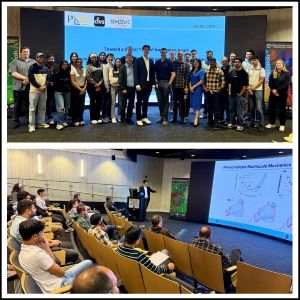
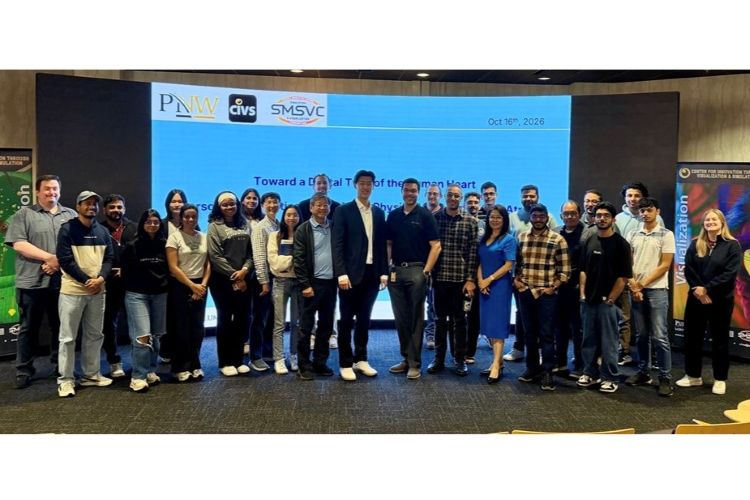
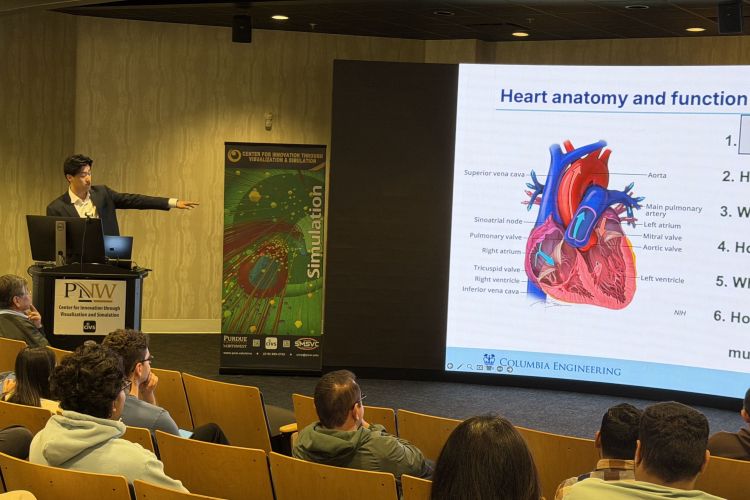
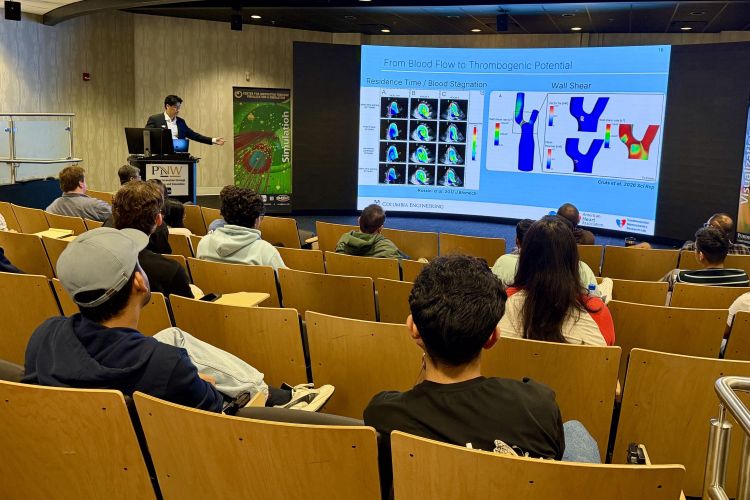
On October 16, CIVS hosted a seminar where Bryan Gan, a PhD candidate in Mechanical Engineering at Columbia University, presented “Toward a Digital Twin of the Human Heart: Personalized Multiscale and Multiphysics Modeling of the Left Atrium.”
Cardiovascular digital twins combine patient-specific clinical data with computational models to create virtual representations of the heart. These models can help researchers study disease mechanisms, explore “what-if” scenarios, and ultimately support diagnosis and treatment planning. The left atrium is particularly important because its electrical activity, contraction, and blood flow are closely connected. In atrial fibrillation, this coordination breaks down, reducing effective contraction and increasing the risk of blood clots and stroke. Its complex shape and highly variable tissue structure also make the left atrium a challenging and interesting system to model. Gan presented their efforts toward a personalized, multiscale, and multiphysics digital twin of the human heart, using the left atrium as a model system. Starting from patient-specific medical imaging and clinical data, we combine computational models of cardiac mechanics, electrophysiology, and blood flow to better understand atrial function and disease.
Bryan Gan works in the Cardiovascular Biomechanics Research Laboratory under the supervision of Professor Vijay Vedula. He received his B.S. in Mechanical Engineering from the University of California, Berkeley. His current research focuses on computational biomechanics and the development of patient-specific digital twins of the human heart. He combines medical imaging, finite element modeling, electrophysiology, fluid mechanics, and multiphysics simulation to study the structure and function of the left atrium. More broadly, his interests lie in using computational modeling and scientific computing to develop tools that connect engineering analysis with clinically meaningful questions in cardiovascular disease.
“The seminar was very insightful, and Bryan’s deep understanding of the background and motivation behind his project inspired me to explore the underlying motivations of my own research more deeply.”


“It was fascinating to learn about Bryan Gan’s research and how computational modeling can be used to better understand the human heart. As someone who works with computational simulations, I know how powerful these tools can be, and it’s amazing to see this type of research in progress. I believe digital twins will play an increasingly important role in the future of healthcare, particularly in improving how we understand, diagnose, and treat cardiovascular diseases.”